



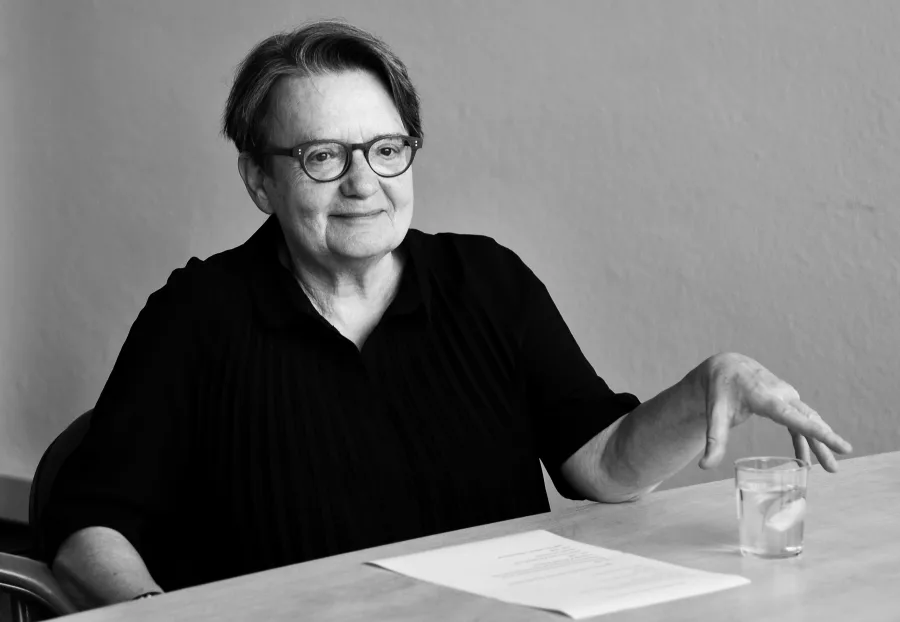
A filmmaker who tells stories about human choices
Agnieszka Holland was born on 28 November 1948 in Warsaw. She is one of Poland’s best-known film directors and screenwriters, with work recognised in Poland and internationally.
Her films often explore freedom, responsibility, civic courage, historical memory and the limits of human choices. These values are close to a school that teaches independent thinking, empathy and respect for truth.
Why Agnieszka Holland?
The decision to choose the school patron was made by the Student Council, which wanted the school to be represented by a person who inspires young people to develop their passions, creativity and courage in pursuing their goals.
Students explained their choice mainly through their interest in filming and creating videos. Young people today are increasingly eager to develop skills connected with media, editing and recording video materials. Agnieszka Holland’s work shows that passion, imagination and hard work can lead to success and help people make their dreams real. Her films raise important topics, encourage reflection and show the power of visual storytelling.
The Student Council also decided to choose a woman as the school patron, noting that only about 20% of schools in Poland have a female patron. Students felt it was important to promote female role models and show how significant women’s roles are in culture, science and social life. Choosing Agnieszka Holland is therefore also a sign of respect for women who achieve success and inspire future generations.
Choosing Agnieszka Holland as the school patron symbolises a successful woman: ambitious, brave and consistent in her actions. Through her work, she has proved that talent and determination can lead to international success and worldwide recognition. For students, she is an example that it is worth developing personal interests and believing in one’s own abilities.
The school community is proud of choosing a patron who inspires young people to act creatively, develop their talents and look at the world with sensitivity and openness.
Creative Path
Holland graduated from FAMU, the Prague film school, in 1971. After returning to Poland, she worked with major figures of Polish cinema, including Krzysztof Zanussi and Andrzej Wajda. Her first feature film, Provincial Actors, became one of the important works of the “cinema of moral anxiety”.
After martial law was declared in Poland, she continued her career abroad. She has made feature films, written screenplays and directed television, while keeping a strong focus on people facing difficult decisions.
Selected films
- Provincial Actors (1978),
- Fever (1980),
- Europa, Europa (1990),
- The Secret Garden (1993),
- In Darkness (2011),
- Spoor (2017),
- Green Border (2023).
Recognition
Her films have received Academy Award nominations: Angry Harvest, Europa, Europa and In Darkness. She has also received many film awards and honours for her contribution to culture.
Why she matters to our school
The school patron shows that culture can be a way to discuss difficult subjects: history, responsibility, violence, exclusion, but also courage and solidarity. Her films encourage students to ask questions, think critically and look for humanity even in complex situations.
Piotrków and In Darkness
The materials provided to the school show the local context of In Darkness. In March 2010, some scenes were shot in Piotrków Trybunalski, including near the Jesuit church and on Rwańska Street. The film tells the fact-based story of Leopold Socha, a sewer worker from Lviv who helped Jewish people hiding in the sewers during the liquidation of the ghetto.
In January 2012, the film had a ceremonial promotion at the Helios cinema in Piotrków. According to local press materials, room no. 3 was named after Agnieszka Holland, and the film drew strong local interest.
The archival material from KurieR - Kultura i Rzeczywistość describes filming in Piotrków Old Town on 22 and 23 March 2010. The crew worked near the Jesuit church, on Pijarska Street and on Rwańska Street, locations that helped create the atmosphere of an occupied city.
The author also recalls a conversation with Agnieszka Holland on set. Holland said that, if technically possible, she would gladly return to Piotrków with the film. She also mentioned a personal sentiment for the city, because her mother’s family came from the Piotrków region.
For the local community, it was an important moment: a world-class film production connected history, cinema and places familiar to residents. For students, it is a useful example that culture is not distant - it can grow out of real streets, memories and local history.
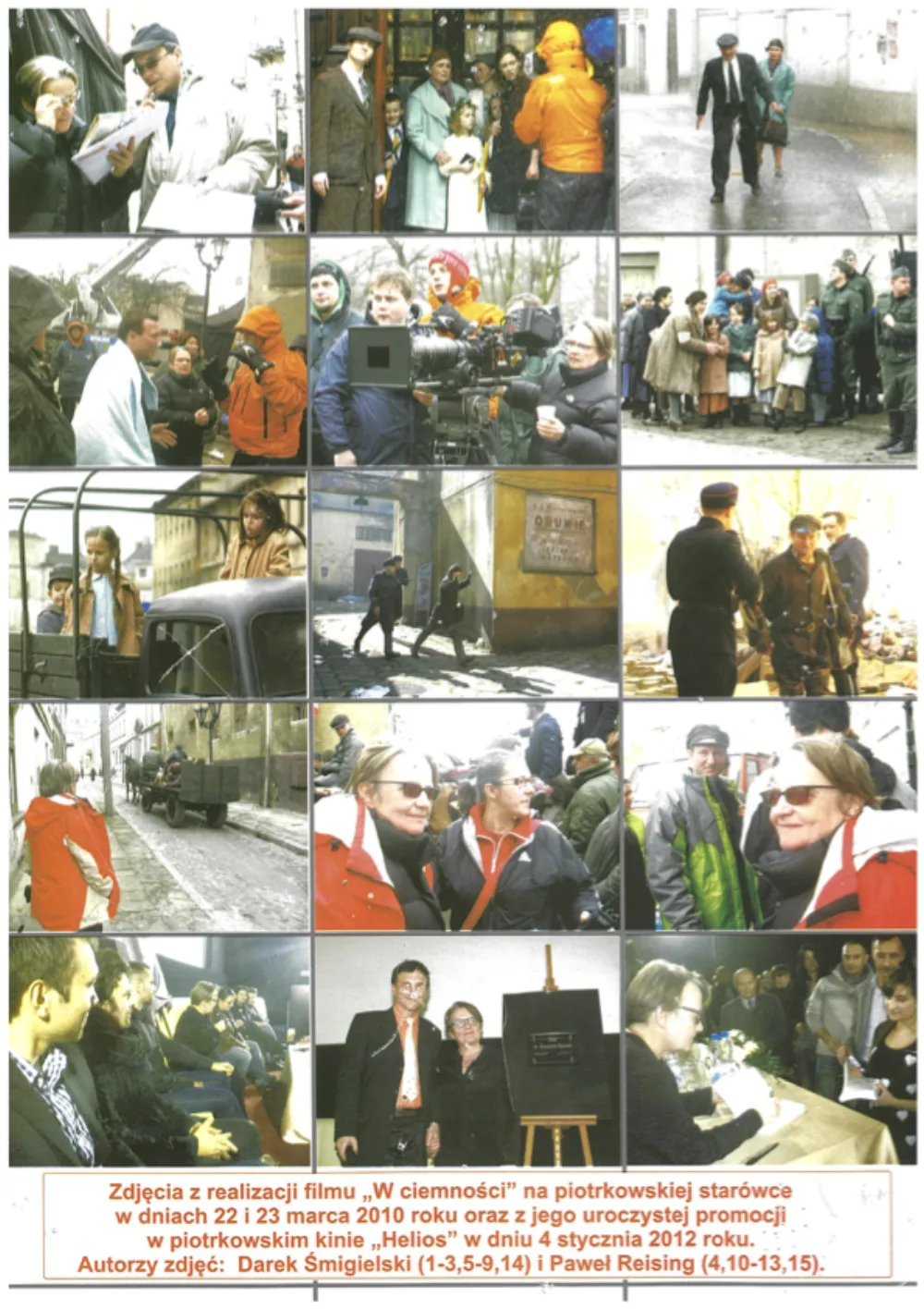
What the archival materials add
The scans describe the behind-the-scenes story of the Piotrków promotion. The author explains that a first meeting with Agnieszka Holland on set led to a conversation and later interview. Holland also mentioned a personal sentiment for Piotrków, because her mother’s family came from the Piotrków region.
The materials show that the film first functioned under the working title Ukryci and later became known as W ciemności / In Darkness. After international screenings and the Academy Award nomination, a ceremonial promotion was organised in Piotrków with members of the film team.
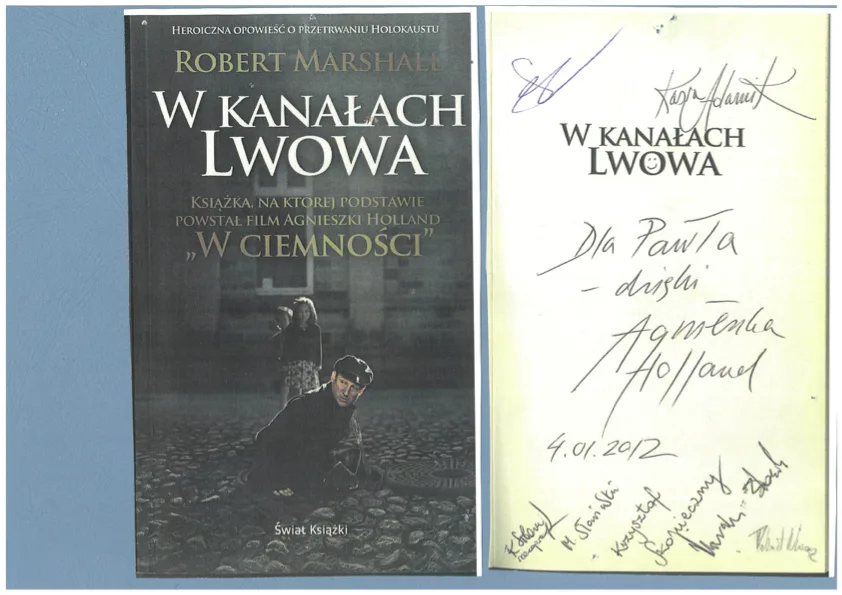
The scans also include Robert Marshall’s book In the Sewers of Lvov. It is not a book by Agnieszka Holland, but it was the basis for the film In Darkness.
The book tells the fact-based story of a group of Jewish people hiding in the sewers of Lviv for fourteen months, and of Leopold Socha, who first helped them for money and later risked his own life and his family’s safety. The scan also shows a dedication page with Agnieszka Holland’s signature dated 4 January 2012.
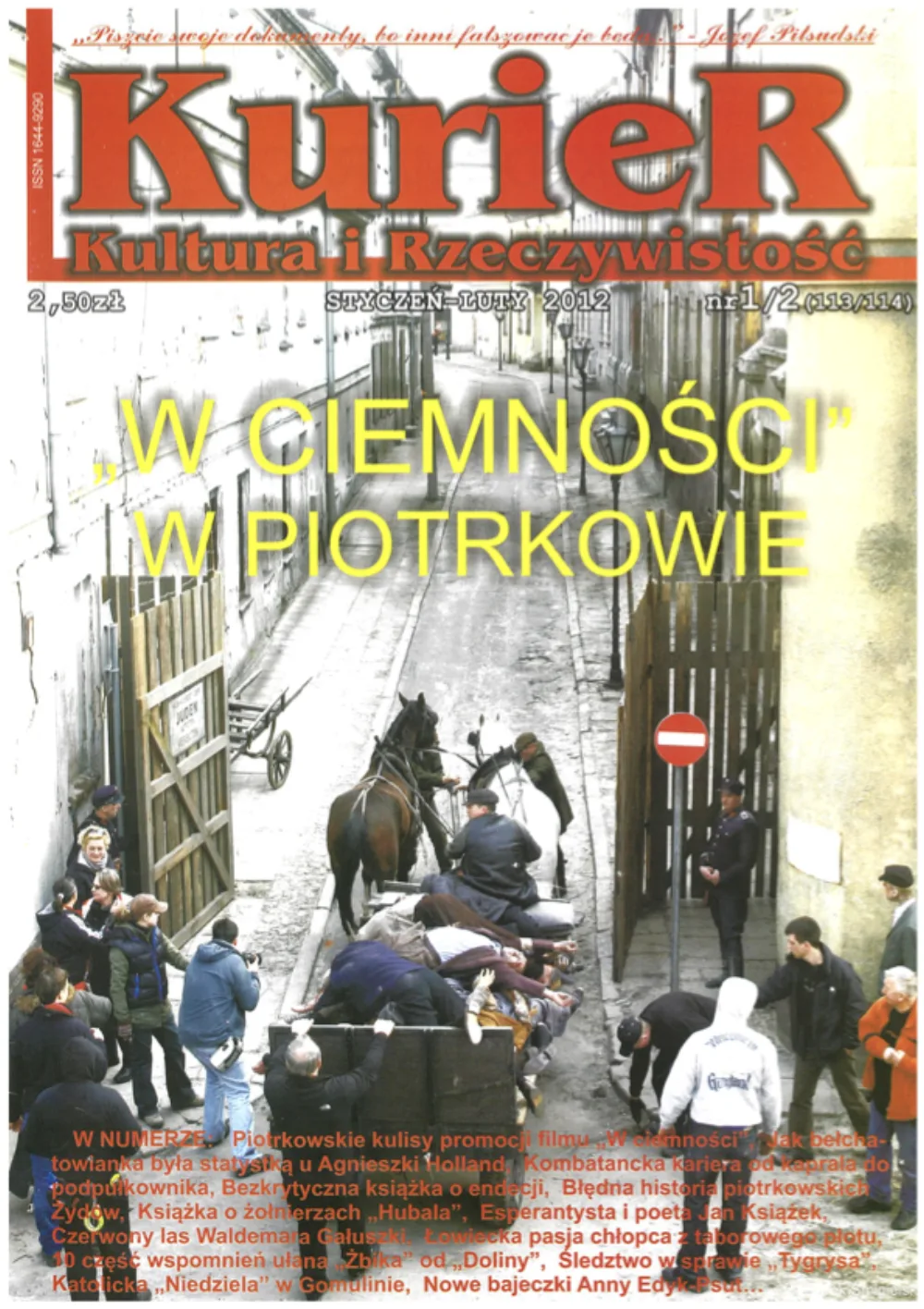
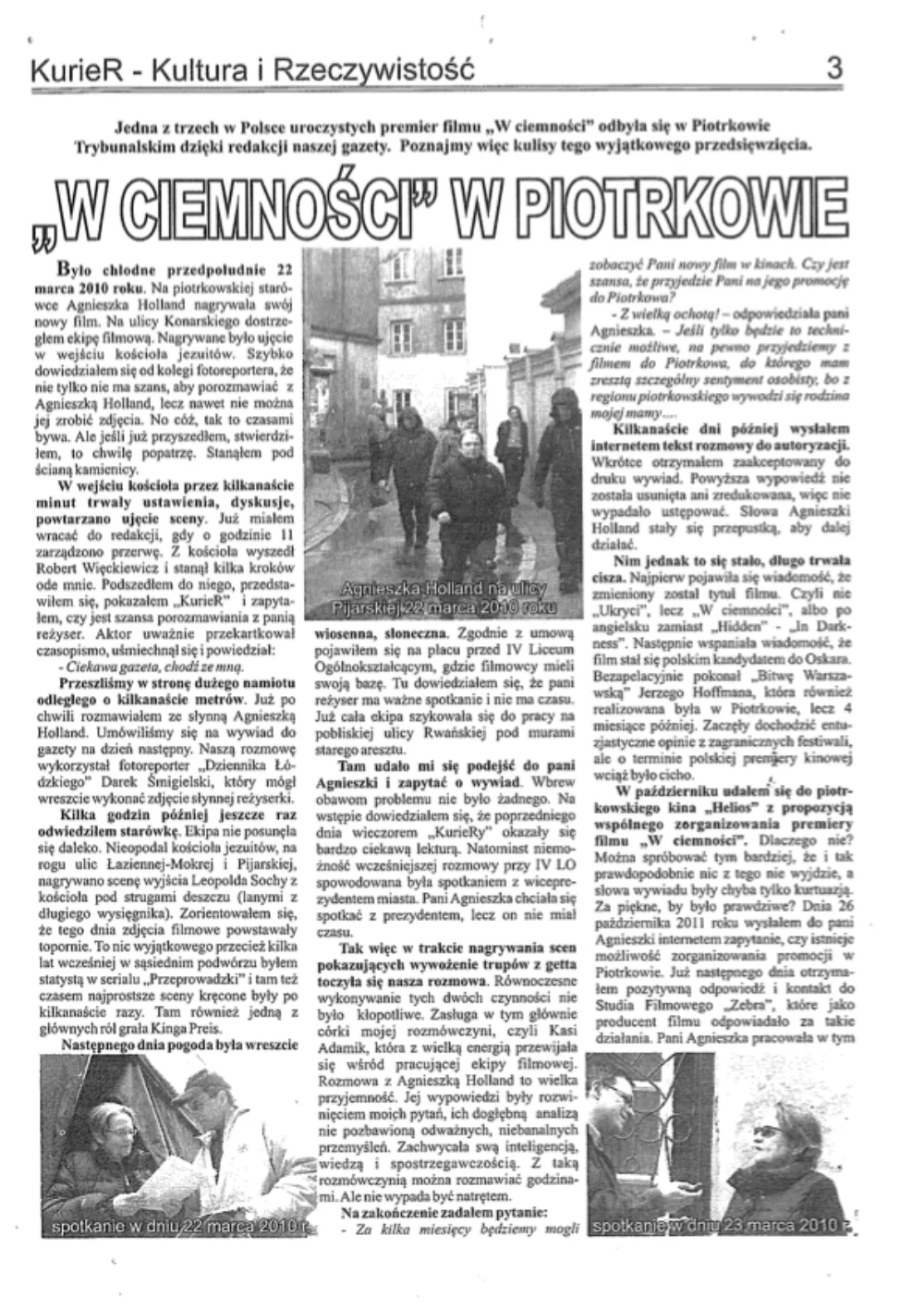
KurieR Article About the Film Promotion
During the meeting, Agnieszka Holland introduced other members of the film team: production designers Katarzyna Sobańska and Marcel Sławiński, her daughter Kasia Adamik, who directed the second unit, producer Wojciech Danowski, and actors Krzysztof Skonieczny, Piotr Głowacki and Marcin Bosak.
Although the meeting was meant to be relaxed, serious topics appeared at the beginning. It turned out that the film almost did not get made. First, part of the budget was withdrawn by the producer from Canada. As a result, the German producer faced serious health problems and was admitted to a psychiatric hospital. Agnieszka Holland admitted that even during production she was worried whether the film could be completed. At first, she did not want to make another film about the Holocaust, because the subject is emotionally exhausting. When she read the screenplay, she did not yet know that it was based on a true story. Katarzyna Sobańska and Marcel Sławiński also said that the film was initially planned to be shot in Lviv.
The large audience could hear many stories and anecdotes. Agnieszka Holland joked about Robert Więckiewicz’s “disasters”: a locked lower back, a burn on his neck from a flashlight, and flat feet caused by carrying a heavy bag. Krzysztof Skonieczny spoke about learning the Lviv dialect. Piotr Głowacki talked about the multilingual film crew and the multilingual dialogue. Marcin Bosak began to speak about a “director’s day”, but could not reveal the plot. Kasia Adamik sympathised with the Canadian sound crew, who did not understand the recorded dialogue at all. Only at the Toronto festival did Agnieszka Holland see relief in their eyes, when subtitles finally allowed them to understand what they had recorded.
At the end, there were questions from the audience and the unveiling of a plaque with the room’s name. From that day, room no. 3 at the Helios cinema was to bear the name of Agnieszka Holland. There was also a long autograph session, lasting around 15 minutes. The creators of In Darkness left Piotrków satisfied, although with a significant delay, and continued to the film’s promotion in Łódź.
The screening followed. After the film ended, the room was silent. Many viewers had tears in their eyes. It was a beautiful and moving film.
The Piotrków press covered the promotion of In Darkness in different ways. Dziennik Łódzki presented the topic most broadly. By contrast, Tydzień Trybunalski treated the event only marginally. An unpleasant moment was an online video which used material from the premiere but in practice served as hidden advertising for the book Piotrków filmowy. The author of the account wrote that he was worried Agnieszka Holland might see it, because her image had been used unlawfully for advertising. Fortunately, this did not happen. Later, he learned that the filmmakers remembered the Piotrków promotion very fondly.
The people of Piotrków did not disappoint. In the following days, tickets for In Darkness screenings were hard to get. Within two months of the premiere, more than 10,000 viewers watched the film at the Helios cinema in Piotrków.
“I was supposed to replace Kinga Preis” - an extra’s memory
Barbara Maron from Bełchatów, who worked as an extra in Agnieszka Holland’s film, wrote down her memories from the film set for the readers of KurieR.
When the scenes were filmed in Piotrków on 22 and 23 March 2010, even the title of the film was still different. Everyone knew that Agnieszka Holland was making a film called Ukryci. Only later did it turn out that the title had changed to W ciemności. Barbara Maron was not from Piotrków, although she had a sentiment for the city: she had graduated from the “Chrobry” secondary school there and had family in the city. Her participation in the film set was accidental. She came to Piotrków for another reason, including looking for work, and unexpectedly heard about the casting call on the radio. Because film had always been her great passion, she decided to try.
About a thousand people came to the casting. Barbara Maron was among roughly 200 selected people. As one of the few, she appeared in a scene with the main characters and was not cut from the film. She recalled that there was little stress, because the extras knew exactly where to stand and what to do. The work, however, was slow and tiring: the same scene was repeated many times while they stood outside in streams of artificial rain in March, near the church doors. It was cold, it lasted the whole shooting day, and the final effect in the film took only several seconds.
She was not the only person from Bełchatów on set. She met an acquaintance and her son, who also took part in the production, though in different scenes shot by Agnieszka Holland’s daughter, Kasia Adamik. As she wrote, during filming it was clear that they were taking part in the creation of something exceptional.
The author also added an anecdote about being asked to replace an actress playing one of the main roles. The set called her when she was already on her way back to Bełchatów by bus. It was late, and the reason for refusing was simply poor transport between Piotrków and Bełchatów. She was asked to replace the actress in scenes inside the church, but she no longer had a way to get there. In the end, she thought it was probably for the best, because those scenes seemed to have been omitted anyway.
She concluded that this is what work on a film set looks like: thousands of takes and countless hours so that the audience can see the final result. She had her several seconds on screen, but kept memories for life from a film set led by “a virtuoso of cinema” - Agnieszka Holland. She congratulated the director and the whole team, adding: “Good job!”.
Values students can take forward
- courage to speak the truth,
- responsibility for words and decisions,
- sensitivity to another person’s fate,
- respect for history and memory,
- openness to culture, languages and different perspectives.
Sources: archival materials provided to the school, Culture.pl, Filmowe Łódzkie and PISF.